Maybe you love goals. You like a fresh planner, a clear target, and the satisfaction of checking boxes. You light up at the thought of a new project, a promotion, or a business milestone.
Or maybe goals make you anxious. You've set too many before and watched them fall apart by February. You wonder if wanting more is somehow unspiritual, or whether you should just take life as it comes and trust God.
Either way, it's worth asking a real question: what does goal setting for Christian women actually look like? Can we be ambitious and faithful at the same time?
The answer is yes, and Scripture shows us how.
Ambition isn't automatically wrong
Some Christian women feel uneasy about ambition, as if wanting to grow, achieve, or lead is inherently prideful. But Scripture doesn't condemn effort, excellence, or wanting to grow. In fact, it praises skill and diligence.
Do you see a man skillful in his work? He will stand before kings; he will not stand before obscure men.
Proverbs 22:29
The Proverbs 31 woman plans, invests, and builds. Lydia ran a successful business. Paul set goals for his ministry, planning trips and hoping to preach the gospel in Spain (Romans 15:24). Ambition for good things, pursued in good ways, honors God.
What Scripture does warn against is selfish ambition:
Do nothing from selfish ambition or conceit, but in humility count others more significant than yourselves.
Philippians 2:3
So the question isn't whether you have goals. It's what's driving them and what you're trusting in.
Check the motive
Before you write down a goal, ask a few honest questions:
- Why do I want this? To serve, to grow, to provide, to steward my gifts? Or to prove something, impress someone, or feel in control?
- Who will this help? Good goals usually bless others, not just ourselves.
- What will this cost? Will pursuing this goal crowd out time with God, my family, or my church?
- Can I hold this with open hands? If God says no or not yet, will I still trust him?
Motives are rarely perfectly pure. That's okay. Bring them to God honestly, and ask him to shape them. He's more interested in your heart than your checklist.
Search me, O God, and know my heart! Try me and know my thoughts!
Psalm 139:23
Make room for God's interruptions
Some of the most important things God does in our lives aren't on our goal list. A friend in crisis who needs you. An unexpected opportunity. A difficult diagnosis. A season of waiting. A new ministry you never saw coming.
The heart of man plans his way, but the LORD establishes his steps.
Proverbs 16:9
Hold your goals firmly enough to pursue them, but loosely enough to let God redirect you. When an interruption comes, it's worth asking: is this a distraction, or is this God's assignment?
Set goals in a few key categories
A balanced set of biblical goals often includes a few different areas of life. Consider choosing one or two goals in each of these:
Spiritual growth. Read through a book of the Bible. Memorize a passage. Join a women's Bible study. Pray for specific people regularly.
Relationships. A weekly date night with your husband. A monthly lunch with a friend. More undistracted time with your kids. Reconnecting with a family member.
Work. A certification, a project, a skill to develop, a business milestone, or simply doing your current job with more excellence and joy.
Health and rest. Regular sleep, movement, and a real weekly day of rest and worship. Your body is a gift to steward, not a machine to push.
Generosity and service. Giving consistently, serving in your church, or helping a neighbor.
You don't need ten goals in each area. One or two meaningful goals per category is plenty. Fewer goals pursued faithfully beat many goals abandoned.
Turn big goals into small steps
Most goals fail not because they're bad but because they're vague. "Be healthier" or "grow my business" are hard to act on. Break each goal into:
- A clear target: What does success look like?
- A first step: What can I do this week?
- A rhythm: When and how often will I work on this?
For example: "Read through the New Testament this year" becomes "Read one chapter a day, five days a week, during my lunch break."
Measure faithfulness, not just results
Not every outcome is in your control. You can't guarantee a promotion, a sale, a healthy pregnancy, or a growing audience. But you can be faithful in the steps you take.
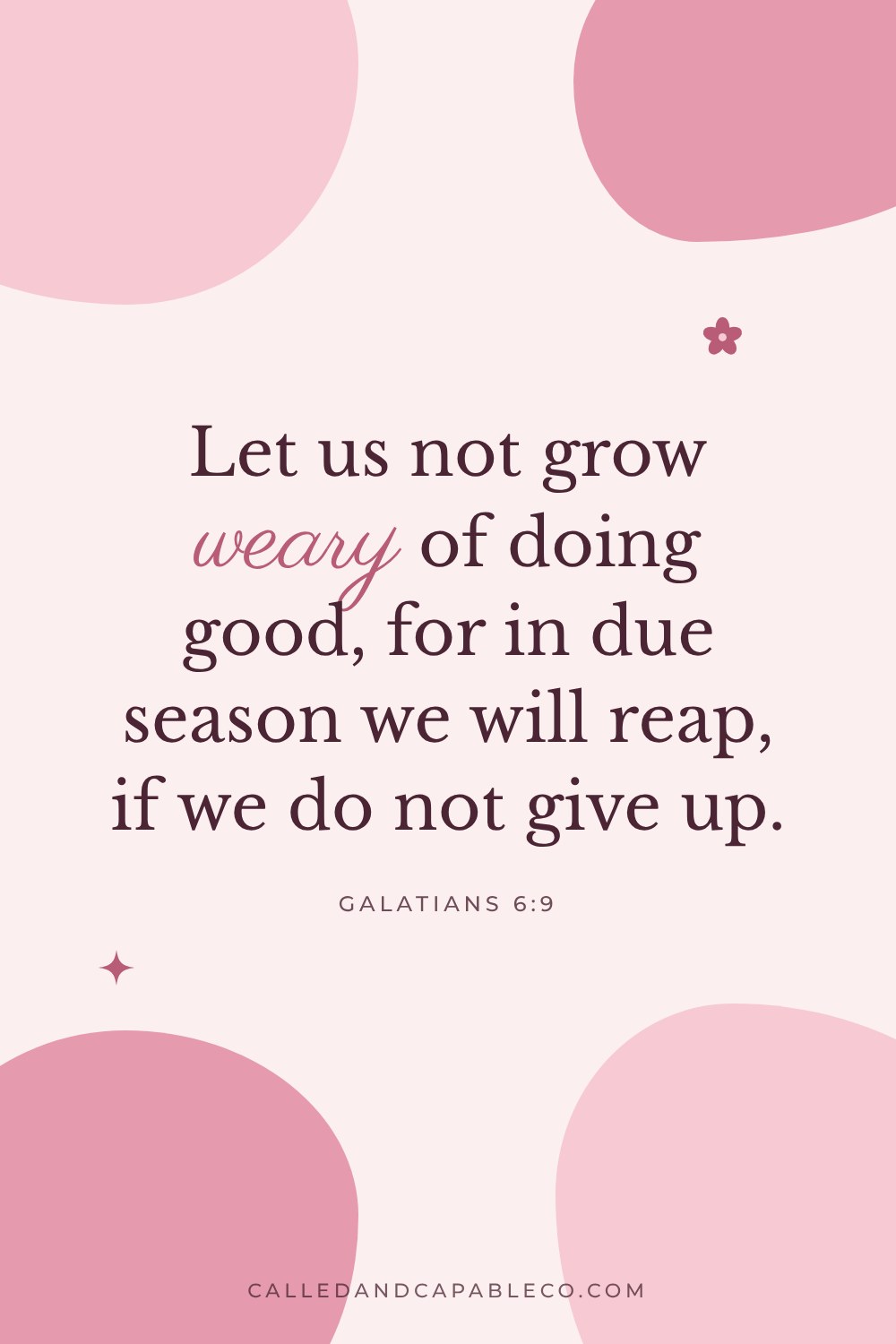
And let us not grow weary of doing good, for in due season we will reap, if we do not give up.
Galatians 6:9
God sees faithful effort, even when results are slow. In the parable of the talents, the master praises his servants by saying, "Well done, good and faithful servant" (Matthew 25:21). Faithful, not just successful.
When you review your goals, ask not only "Did I hit the number?" but "Was I faithful with what God gave me?"
When you miss your goals
You will miss some goals. Life will interrupt. You'll overestimate what you can do. That's not a moral failure. It's an opportunity to learn, adjust, and receive grace.
Ask:
- Was this goal realistic for my season?
- Did my circumstances change?
- Is this still important, or should I let it go?
- What's one small step to start again?
Then move forward without shame.
Rest in your identity
Most importantly, remember that your worth isn't in your goals. If you hit every one, God doesn't love you more. If you miss them all, he doesn't love you less. Your identity is secure in Christ.
For by grace you have been saved through faith. And this is not your own doing; it is the gift of God, not a result of works, so that no one may boast.
Ephesians 2:8–9
That truth doesn't make goals pointless. It makes them freeing. You're not working for God's approval. You're working from it. Goals simply become a way to steward the life, gifts, and opportunities he's given you.
Ambition without anxiety is possible. It's what happens when your plans are big, your hands are open, and your heart is resting in Christ.
Our study Fruitful: Planning Your Year in God's Word walks through what Scripture says about fruitfulness, planning, and goals over four weeks, about twelve minutes a day. It starts with abiding in Christ before it ever gets to goals, and includes printable pages for your word of the year, goals for each area of life, and quarterly check-ins. It's $10.
Common questions
Is it wrong for Christians to set goals?
No. Scripture praises diligence and skill (Proverbs 22:29). It warns against selfish ambition (Philippians 2:3) and planning as if we control the future (James 4:13–15).
What are good goals for a Christian woman?
Balanced goals often include spiritual growth (like reading a book of the Bible), relationships, work, and health and rest. One or two meaningful goals in each area is plenty.
Scripture quotations are from the ESV® Bible (The Holy Bible, English Standard Version®), © 2001 by Crossway, a publishing ministry of Good News Publishers. Used by permission. All rights reserved.