The book of Ruth doesn't have miracles, battles, or prophets. There are no parted seas or voices from heaven. It has a grieving widow, a foreign daughter-in-law, a barley field, a lot of hard work, and a legal meeting at the city gate. And yet through these ordinary days, God was doing something extraordinary.
If you've ever felt like your work is too ordinary to matter, this book of Ruth Bible study is for you. Ruth's story is one of the clearest pictures in Scripture of how God works through faithful, everyday labor.
A family in crisis
Ruth's story begins with famine. During the time of the judges, a man named Elimelech took his wife, Naomi, and their two sons from Bethlehem to Moab, a foreign country with foreign gods, looking for food.
It was meant to be a short stay. It became ten years. Elimelech died. Both sons married Moabite women, Orpah and Ruth. Then both sons died, too.
so that the woman was left without her two sons and her husband.
Ruth 1:5
Naomi was left with nothing: no husband, no sons, no inheritance, far from home. It's one of the loneliest verses in Scripture.
Many women carry a version of that loss: the loss of a spouse, a child, a marriage, a career, a dream. If that's you, the book of Ruth doesn't rush you past the grief. But it does invite you to keep reading.
A woman who chose to stay
When Naomi heard that the famine in Bethlehem had ended, she decided to go home. She urged her daughters-in-law to return to their own families, where they would have a better chance at remarriage and security. Orpah tearfully went back. Ruth refused:
But Ruth said, "Do not urge me to leave you or to return from following you. For where you go I will go, and where you lodge I will lodge. Your people shall be my people, and your God my God."
Ruth 1:16
This was a costly choice. Ruth was choosing poverty, widowhood in a foreign land, and an uncertain future. She was choosing loyalty to Naomi and faith in the God of Israel over the familiar comfort of home.
Ruth's commitment wasn't just emotional. It was covenantal. She was binding herself to Naomi, her people, and her God for life.

She went to work
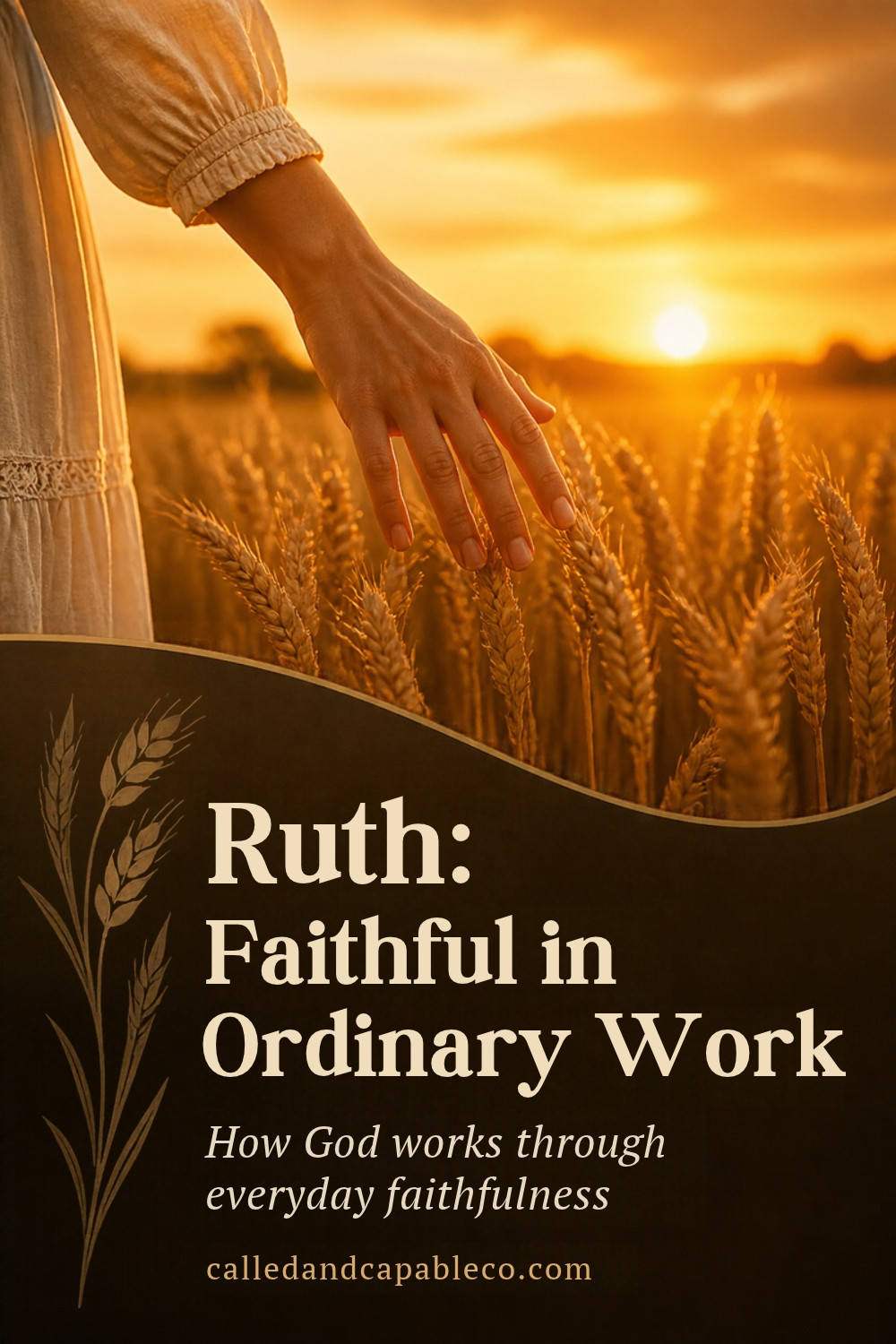
When the two women arrived in Bethlehem, they had nothing. No land, no income, no provision. So Ruth did what she could. She went into the fields to glean, picking up the leftover grain the harvesters missed.
God's law made provision for the poor through gleaning. Landowners were not to harvest the very edges of their fields or go back for what they dropped. That grain was left "for the poor and for the sojourner" (Leviticus 19:9–10). Ruth was both.
Gleaning was humble, tiring, physical work. It was the kind of work done by people with no other options. And yet Ruth didn't wait for a better opportunity. She took the work in front of her and did it with diligence.
When Boaz arrived and asked about her, his foreman reported that Ruth had been working "from early morning until now, except for a short rest" (Ruth 2:7). She was known for her work ethic before anyone knew much else about her.
She "happened" to come to the right field
So she set out and went and gleaned in the field after the reapers, and she happened to come to the part of the field belonging to Boaz, who was of the clan of Elimelech.
Ruth 2:3
That word "happened" is almost a wink from the author. Ruth didn't know it, but God was guiding every step. Of all the fields in Bethlehem, she ended up in the one belonging to Boaz, a relative of Naomi's late husband, a man who would become her redeemer.
This is what theologians call providence: God's quiet, constant care over every detail of our lives, even the ones that seem random. Ruth was simply going to work. God was writing redemption.
Faithfulness in the small things
As the story continues, Boaz shows Ruth kindness, Naomi devises a bold plan, and Boaz agrees to act as kinsman-redeemer, marrying Ruth and restoring the family's inheritance. But it all begins with Ruth faithfully doing ordinary work in a field.
That's a pattern throughout Scripture. Joseph was faithful in Potiphar's house and in prison before he was faithful in Pharaoh's palace. David was faithful with sheep before he was faithful with a kingdom. Jesus said, "One who is faithful in a very little is also faithful in much" (Luke 16:10).
Your ordinary faithfulness matters. The reports, the shifts, the meetings, the lessons, the patients, the phone calls. God sees them, and he uses them.
What Ruth teaches us about work
Here are a few lessons for working women from Ruth's story:
1. No work is beneath us. Ruth did humble work with dignity. Whatever your role, it can be done faithfully for God's glory.
2. Diligence speaks. Ruth's reputation was built through steady, faithful effort. Your work ethic is part of your witness.
3. Loyalty matters. Ruth's commitment to Naomi shaped everything. Faithfulness to people, not just tasks, is central to godly work.
4. God is at work in the ordinary. You may never see the full picture of how God is using your daily work, but he is. The "random" circumstances of your life are in his hands.
5. Grief and hope can coexist. Ruth and Naomi worked while grieving. God met them in the middle of their loss.
The bigger story
Ruth's story ends with a wedding and a baby. Ruth and Boaz have a son named Obed. The women of Bethlehem rejoice with Naomi: "Blessed be the LORD, who has not left you this day without a redeemer" (Ruth 4:14).
Then the book closes with a genealogy. Obed became the father of Jesse, and Jesse became the father of David, Israel's greatest king. And centuries later, Matthew includes Ruth by name in the genealogy of Jesus Christ (Matthew 1:5).
A foreign widow gleaning in a field became the great-grandmother of a king and an ancestor of the Messiah. God took her ordinary faithfulness and wove it into the story of redemption.
Your ordinary faithfulness may matter more than you'll ever know this side of heaven.
Bringing Ruth into your workweek
- Offer your most ordinary task to God as an act of worship.
- Look for God's hand in the "coincidences" of your week.
- Show loyal love to a coworker, friend, or family member going through a hard season.
- Trust God with the outcome when your work feels small or unseen.
Study Ruth for yourself
Our study Ruth: Faithful in the Field walks through the book of Ruth one chapter per week over four weeks, about twelve minutes a day. Each day includes a reading, a short reflection, a question to answer, and one action to carry into your workday, plus reference pages on hesed and the kinsman-redeemer. It's $10 as an instant download.
Common questions
What is the main message of the book of Ruth?
Ruth shows God's quiet, faithful care in ordinary life. Through loss, hard work, and loyal love, God provides a redeemer and continues the family line that leads to David and Jesus.
Why is Ruth important in the Bible?
Ruth, a Moabite woman, became the great-grandmother of King David and is named in Jesus' genealogy (Matthew 1:5). Her story shows God welcoming outsiders into his people.
Scripture quotations are from the ESV® Bible (The Holy Bible, English Standard Version®), © 2001 by Crossway, a publishing ministry of Good News Publishers. Used by permission. All rights reserved.