For a lot of women, Proverbs 31 feels less like encouragement and more like a report card. She rises while it is still night. She sews, cooks, buys real estate, plants a vineyard, runs a business, cares for the poor, and her children call her blessed. Meanwhile, you're happy if everyone has clean socks and dinner involves a vegetable.
If you've ever closed your Bible after reading Proverbs 31 feeling more discouraged than encouraged, you're not alone. But Proverbs 31 was never meant to be a checklist. When we understand what it actually is, it becomes one of the most encouraging passages in Scripture for working women.
It's a poem, not a schedule
Proverbs 31:10–31 is an acrostic poem in Hebrew. Each verse begins with the next letter of the Hebrew alphabet, from the first letter to the last. It's a carefully crafted work of art praising a woman of strength and wisdom from A to Z.
That literary form tells us something. This isn't a daily planner. It's a portrait. It describes a life, not a single day. It celebrates wisdom lived out across many years and many seasons, not a woman doing every one of these things before breakfast.
The poem was also first framed as words a mother taught her son (Proverbs 31:1). It's partly a picture of what kind of wife to value: a woman whose worth is "far more precious than jewels" (Proverbs 31:10). It's praise, not pressure.
She is a woman of strength
The opening line asks, "An excellent wife who can find?" (Proverbs 31:10). The Hebrew word translated "excellent" carries the idea of strength, capability, and worth. It's the same word used to describe Ruth, whom Boaz calls "a worthy woman" (Ruth 3:11).
Interestingly, in the Hebrew Bible, the book of Ruth follows right after Proverbs. Some have noticed that Ruth, a poor foreign widow, is presented as a real-life example of this worthy woman. She didn't own fields or run a business. She gleaned leftover grain. But she was faithful, loyal, hardworking, and feared the Lord.
That's encouraging. The worthiness praised in Proverbs 31 isn't about wealth or perfection. It's about character.
She is a working woman
It's striking how much of this woman's praise involves work:
She considers a field and buys it; with the fruit of her hands she plants a vineyard.
Proverbs 31:16
She also "perceives that her merchandise is profitable" (v. 18), makes linen garments and sells them, and delivers sashes to the merchant (v. 24). She trades, plans, manages, invests, and produces things of value. Her work benefits her household and her community.
So if you've ever wondered whether a woman can work and still be godly, Proverbs 31 answers clearly. Her capability and industry are part of her praise, not a distraction from it. Her husband trusts her, and "he will have no lack of gain" (v. 11).
That doesn't mean every woman must work outside the home or run a business. Families make different choices in different seasons, and those choices should be made prayerfully and wisely. But it does mean that a woman's work, wherever she does it, can honor God.
She cares for others
This woman's work isn't just about profit. "She opens her hand to the poor and reaches out her hands to the needy" (v. 20). Her strength is used to serve. Her household is well cared for, and she thinks ahead to protect them (v. 21).
Her words are also marked by care: "She opens her mouth with wisdom, and the teaching of kindness is on her tongue" (v. 26). In a working world full of sharp emails and harsh criticism, that's a beautiful example.
Her strength comes from somewhere deeper
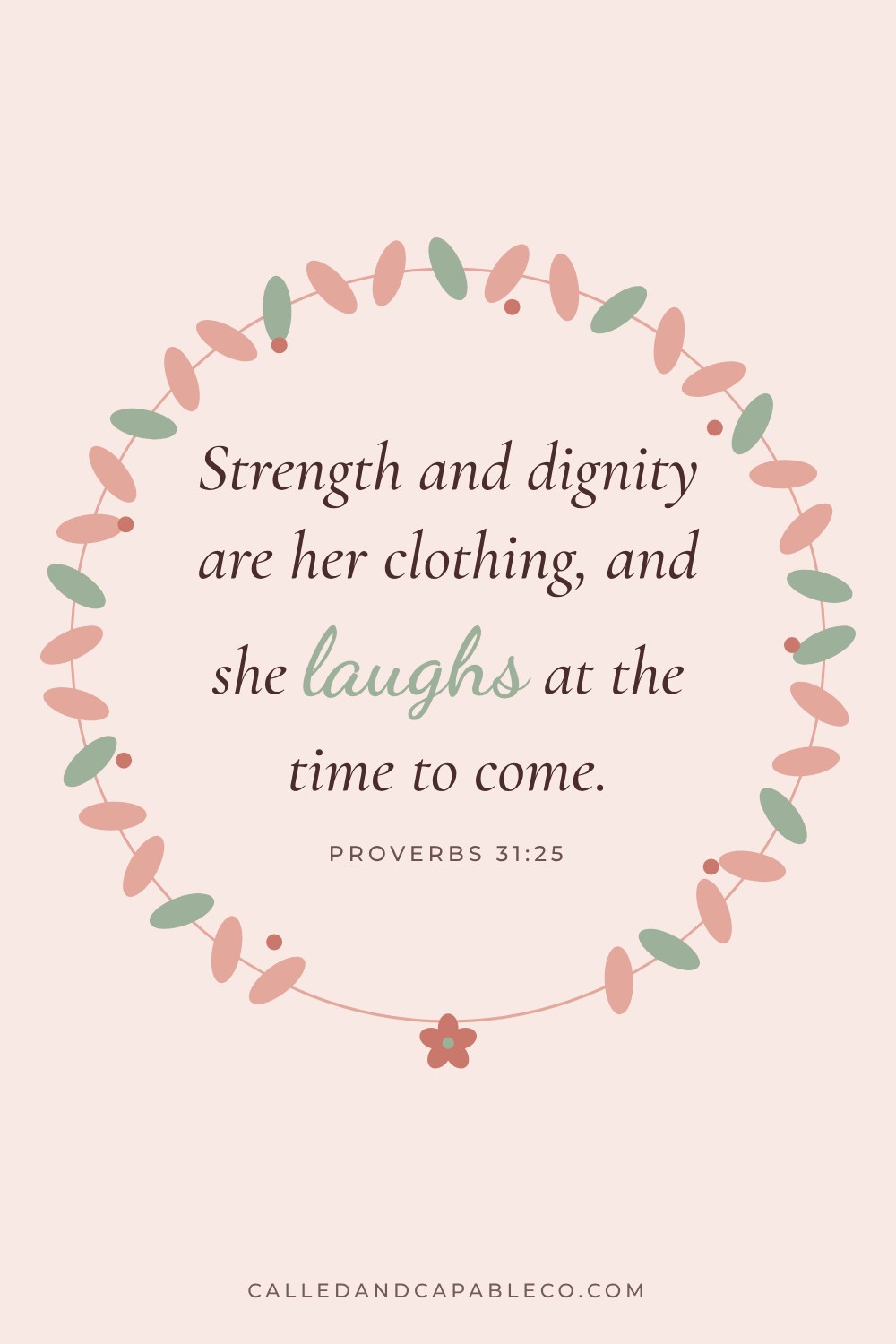
Strength and dignity are her clothing, and she laughs at the time to come.
Proverbs 31:25
She isn't anxious about the future. She can laugh at what's coming. Why? It's not just because she's well organized, though she is. The poem tells us the real reason at the end:
Charm is deceitful, and beauty is vain, but a woman who fears the LORD is to be praised.
Proverbs 31:30
The root of everything is the fear of the Lord, a reverent, loving trust in God. That's the point of the whole book of Proverbs, which begins, "The fear of the LORD is the beginning of knowledge" (Proverbs 1:7). The book opens and closes with the fear of the Lord.
Her productivity flows from her faith, not the other way around. She isn't trying to earn God's approval by being impressive. She's living wisely because she knows and reveres God.
What to take from Proverbs 31
Instead of measuring yourself against her, try asking a few different questions:
- Where does my strength come from? Am I trying to hold everything together on my own, or am I leaning on God?
- Is my work a blessing to others? Not "Am I doing enough?" but "Who am I serving through this?"
- How are my words? Is kindness on my tongue at home and at work?
- Can I laugh at the time to come? What would it look like to trust God with tomorrow instead of bracing for it?
- Do I fear the Lord? Is my reverence for God the foundation of my life?
These questions turn Proverbs 31 from a guilt trip into an invitation.
Seasons matter
Remember that this poem describes a whole life. You might be in a season of newborns and survival mode. You might be in a season of building a career. You might be caring for aging parents. You don't have to embody every verse right now.
Some verses may describe your current season. Others may come later. Others may never fit your particular calling. That's okay. The heart of the passage, the fear of the Lord, applies in every season.
The grace underneath it all
Here's the deeper good news. No woman perfectly lives out Proverbs 31. But there is one who perfectly fulfilled all of God's wisdom: Jesus Christ. Paul says Christ "became to us wisdom from God, righteousness and sanctification and redemption" (1 Corinthians 1:30).
You are not saved by being the Proverbs 31 woman. You're saved by Christ. And in him, you're growing, slowly and imperfectly, into a woman of strength and dignity. Your failures are covered. Your growth is his work.
So the next time you read Proverbs 31, don't read it as a list of everything you're failing at. Read it as a beautiful picture of what God's wisdom looks like in a woman's life, and ask him to keep growing that wisdom in you.
The Called & Capable Monthly membership, launching January 2027, brings one new 4-week Bible study to your inbox each month, about twelve minutes a day, with a Monday encouragement email and a weekly Reflection Guide. In the meantime, our free Monday Reset study is a great place to start.
Common questions
Is the Proverbs 31 woman real?
Proverbs 31:10–31 is a poem portraying a wise, God-fearing woman across a lifetime. Some see Ruth, called "a worthy woman" in Ruth 3:11, as a real-life example of this character.
Did the Proverbs 31 woman work?
Yes. She buys a field, plants a vineyard, makes and sells goods, and manages her household, and Scripture praises her for it.
Scripture quotations are from the ESV® Bible (The Holy Bible, English Standard Version®), © 2001 by Crossway, a publishing ministry of Good News Publishers. Used by permission. All rights reserved.