Hospitality can feel like one more thing busy women are supposed to be good at. We picture a beautifully set table, a homemade three-course meal, fresh flowers, and a house without laundry piled on the couch. Then we look at our calendars, our budgets, and our kitchen floors, and we decide hospitality is for another season.
But Scripture's picture of biblical hospitality is much simpler, and much more powerful, than what we often imagine. One of the best examples is Lydia, a working woman in Acts 16 whose home became the first gathering place of the church in Philippi.
If you've ever wanted to open your home but felt too busy or too unprepared, Lydia's story is for you.
Lydia opened her home immediately
Lydia was a businesswoman who sold purple goods, an expensive luxury product. She was from Thyatira but was doing business in Philippi. On the Sabbath, she went to a place of prayer by the river, where she heard Paul preach the gospel. The Lord opened her heart, and she believed.
What she did next is remarkable:
And after she was baptized, and her household as well, she urged us, saying, "If you have judged me to be faithful to the Lord, come to my house and stay." And she prevailed upon us.
Acts 16:15
Lydia had just come to faith. She hadn't taken a hospitality class. She didn't wait until she had a perfect plan or a guest room ready. She simply opened her home. And she was persistent about it. "She prevailed upon us," Luke says. She wouldn't take no for an answer.
Her hospitality flowed out of her faith. God had welcomed her into his family, so she welcomed others into her home.
Her home became a gathering place
Later in Acts 16, Paul and Silas were beaten, thrown into prison, and put in stocks for casting a spirit out of a slave girl. After an earthquake, the conversion of the jailer and his family, and their release, where did they go?
So they went out of the prison and visited Lydia. And when they had seen the brothers, they encouraged them and departed.
Acts 16:40
Lydia's home had become the place where believers met. Her house was a refuge for persecuted missionaries and a center for the young church. Bruised and battered, Paul and Silas went to the place they knew they'd be welcomed.
That's what hospitality can do. It creates places of refuge, encouragement, and fellowship in a hard world.
What biblical hospitality really is
The Greek word for hospitality in the New Testament is philoxenia, which literally means "love of strangers." Hospitality, in Scripture, is less about entertaining and more about welcoming.
There's a big difference between the two:
- Entertaining focuses on impressing guests. It asks, "What will they think of my home, my food, my decor?"
- Hospitality focuses on serving guests. It asks, "How can I help them feel welcome, known, and cared for?"
Entertaining can feel exhausting and performance-driven. Hospitality is simpler and more freeing. It invites people into your real life, mess and all.
Scripture calls all Christians to hospitality, not just those with big homes or lots of free time:
Show hospitality to one another without grumbling. As each has received a gift, use it to serve one another, as good stewards of God's varied grace.
1 Peter 4:9–10
Do not neglect to show hospitality to strangers, for thereby some have entertained angels unawares.
Hebrews 13:2
Simple hospitality ideas for busy women
You don't need to quit your job or remodel your kitchen to practice hospitality. Here are some realistic ideas for working women:
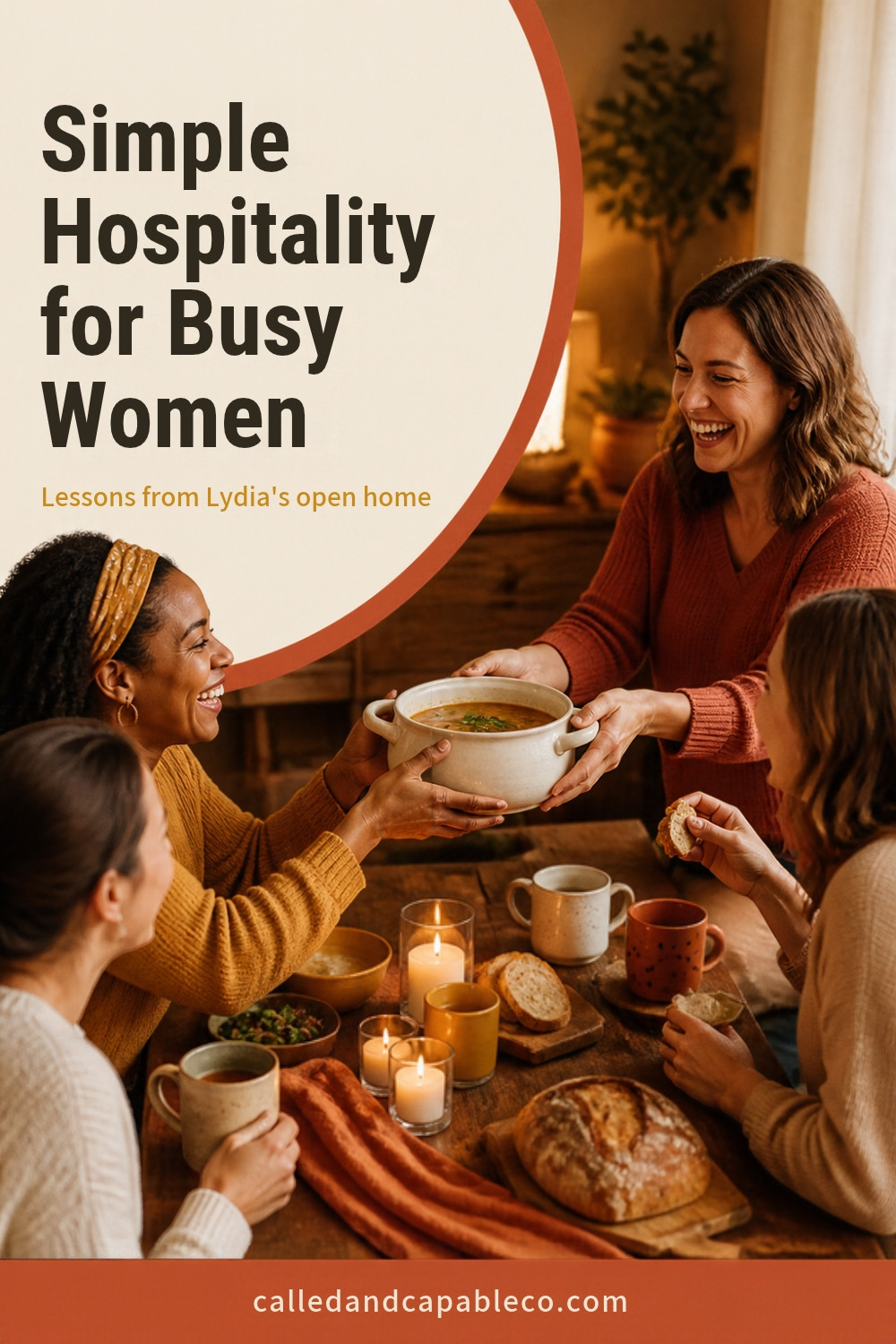
Invite people into your real life. Ask a friend or new family from church to join your ordinary Tuesday dinner, even if it's tacos from a box or a frozen lasagna. People remember feeling welcome, not the menu.
Keep the menu simple. Soup and bread. Pizza. A slow cooker meal. Breakfast for dinner. Order takeout and use real plates. Simple food means you can actually enjoy your guests.
Use your lunch break. Hospitality doesn't have to happen at home. Invite a coworker to lunch or coffee. Ask a new employee to eat with you. A restaurant table can be a place of welcome.
Host on a regular rhythm. Choose a realistic frequency, like once a month, and put it on your calendar. Regular, simple hospitality is better than rare, elaborate events.
Share the work. Make it a potluck. Ask guests to bring a side or dessert. Let your kids help set the table. Hospitality is a team effort.
Open your home to your church. Host a small group or Bible study, invite a new family over after church, or have college students for Sunday lunch.
Remember the lonely. Widows, single adults, international students, and people far from family often go years without being invited into someone's home. Your simple dinner could mean the world to them.
Use what God has given you
Lydia's business likely gave her a larger home and the resources to host guests. She used those gifts for God's people.
What has God given you? Maybe it's a home with a big table. Maybe it's a small apartment with a cozy couch. Maybe it's a car you could use to give someone a ride, a flexible schedule one day a week, a gift for cooking, or a knack for making people feel at ease. All of it can be offered back to God.
Your work, too, may have given you resources: income to buy groceries for guests, skills in organizing, or connections that could help someone find a job. Those are gifts to steward.
Let go of perfection
The biggest obstacle to hospitality for many women isn't time. It's perfectionism. We don't invite people over because the house isn't clean enough, the meal isn't fancy enough, or we're not "good at" hosting.
But people don't need perfection. They need welcome. In fact, a slightly messy house can make guests feel more at ease. It tells them they don't have to be perfect either.
The goal isn't to impress. It's to love.
We were welcomed first
Ultimately, hospitality reflects the gospel. We were strangers to God, separated from him by sin. And in Christ, he welcomed us into his family.
Therefore welcome one another as Christ has welcomed you, for the glory of God.
Romans 15:7
When we open our doors, we get to show others a small picture of that welcome. Every simple meal shared, every coffee with a coworker, every invitation to a lonely friend reflects the God who welcomed us first.
Learn more from Lydia
Our five-day study, Lydia: Faith in the Marketplace, walks through Lydia's story in Acts 16, including her faith, her work, and her hospitality. Day 4 focuses on her invitation, "come to my house," and Day 5 on the church in her living room. Each day takes about twelve minutes, and it's just $2 as an instant download.
Common questions
What is biblical hospitality?
The New Testament word for hospitality means "love of strangers." Biblical hospitality is welcoming others, especially believers and those in need, into your life and home as an expression of God's welcome to us.
How can I practice hospitality if I work full-time?
Keep it simple and regular: invite people into your normal routines, serve easy meals, use lunch breaks for coffee or lunch with a coworker, or host once a month.
Scripture quotations are from the ESV® Bible (The Holy Bible, English Standard Version®), © 2001 by Crossway, a publishing ministry of Good News Publishers. Used by permission. All rights reserved.