Tucked into Acts 16 is a short story about a woman many of us skip right past. Her name was Lydia, and her story takes up only a handful of verses. But those verses say a great deal about faith, work, and what God does with an ordinary working woman. Lydia in the Bible is a quiet example that working women often miss.
If you have ever wondered whether your job and your faith belong together, or whether God really sees women who spend most of their week working, Lydia is worth getting to know.
Setting the scene
In Acts 16, the apostle Paul and his companions have just received a vision of a man from Macedonia pleading, "Come over to Macedonia and help us" (Acts 16:9). So they travel across the sea to Philippi, a leading city in the region and a Roman colony.
Philippi didn't seem to have a synagogue, which typically required at least ten Jewish men. So on the Sabbath, Paul and his friends went outside the city gate to the riverside, where they supposed there was a place of prayer. There they found a group of women gathered to pray, and they sat down and spoke to them.
Among those women was Lydia.
Who was Lydia?
One who heard us was a woman named Lydia, from the city of Thyatira, a seller of purple goods, who was a worshiper of God. The Lord opened her heart to pay attention to what was said by Paul.
Acts 16:14
In just one verse, Luke tells us a lot:
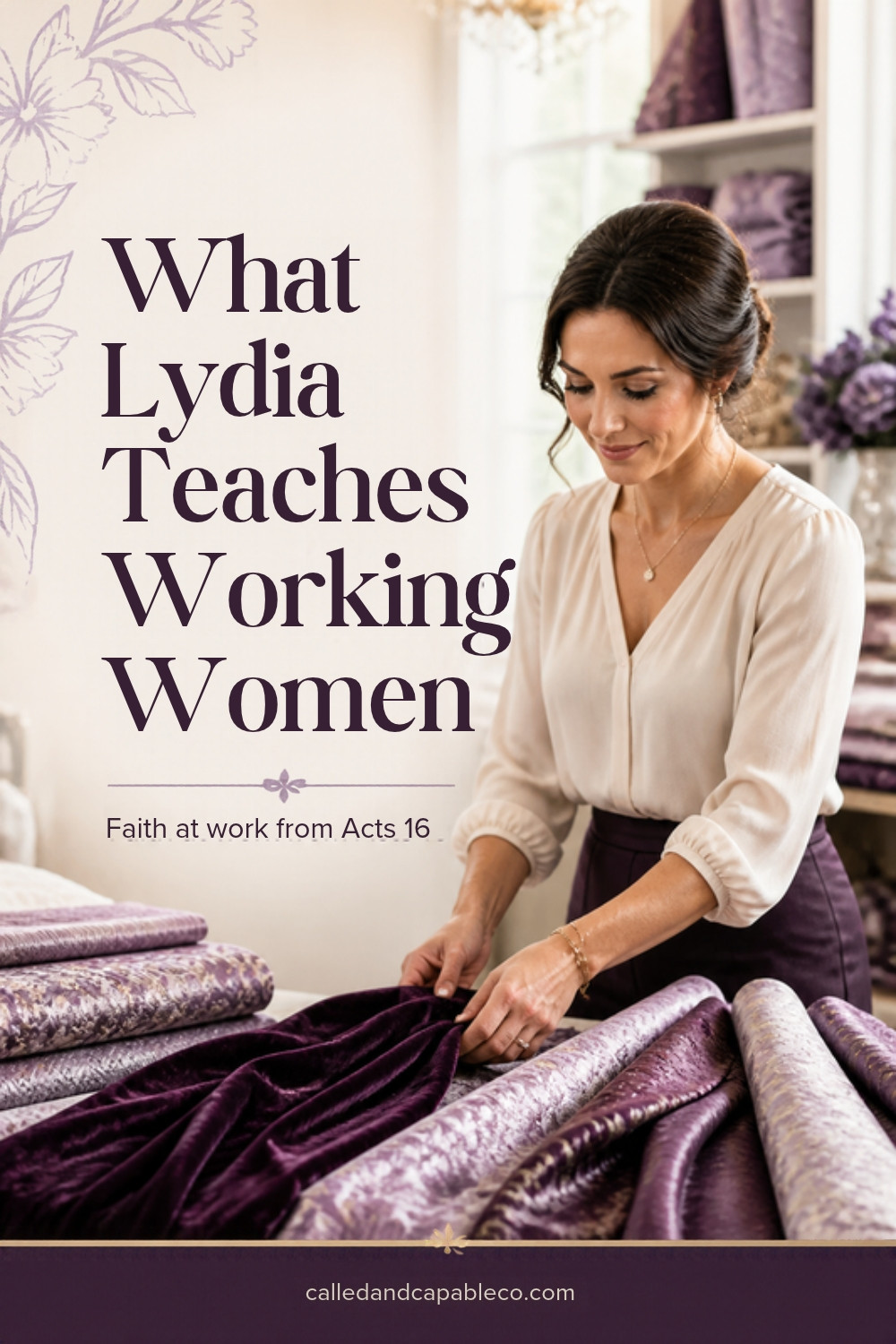
- She was a businesswoman. Lydia sold purple goods, a luxury product in the ancient world. Purple dye was expensive and difficult to produce, so her customers were likely wealthy and influential. Running this kind of business meant managing suppliers, pricing, travel, reputation, and customers.
- She was far from home. Lydia came from Thyatira, a city in Asia Minor known for its dye trade. She was doing business hundreds of miles away in Philippi, likely having relocated for her work.
- She was already seeking God. She was "a worshiper of God," someone who believed in the God of Israel but had not yet heard the good news about Jesus.
- She made time to pray. Even without a synagogue in town, she found her way to the riverbank on the Sabbath to pray with other women.
It's worth noticing how Luke introduces her. Before we learn anything about her household or her conversion, we learn her trade. Scripture doesn't apologize for Lydia's career or treat it as a distraction from her faith. It simply tells us who she was: a working woman who worshiped God.

The Lord opened her heart
The most important line in her story is this one: "The Lord opened her heart to pay attention to what was said by Paul."
Lydia was successful, capable, and religious. She was already praying and seeking God. But none of that saved her. God did. He opened her heart so that she could understand and believe the gospel.
That's a deep comfort for us. Your faith doesn't ultimately depend on how disciplined or impressive you are. It depends on a God who opens hearts. He opened Lydia's on an ordinary Sabbath by a river, in the middle of a busy working life. He can meet you in an ordinary week, too.
It also means we can pray with hope for the people we work with. The same God who opened Lydia's heart can open the hearts of our coworkers, clients, and friends.
Her faith changed her household
And after she was baptized, and her household as well, she urged us, saying, "If you have judged me to be faithful to the Lord, come to my house and stay." And she prevailed upon us.
Acts 16:15
Lydia's faith didn't stay private. Her household was baptized with her, which suggests she was the head of her home and likely had family members or servants who worked for her. Her new faith touched everyone under her roof.
And immediately, she opened her home. She urged Paul and his companions to stay with her, and she wouldn't take no for an answer. "She prevailed upon us," Luke says. Lydia was persuasive and generous, qualities that probably served her well in business, now put to work for the kingdom.
Her home became a church
Later in Acts 16, Paul and Silas are beaten and thrown into prison for casting a spirit out of a slave girl. After an earthquake, the conversion of the jailer, and their release, where do they go?
So they went out of the prison and visited Lydia. And when they had seen the brothers, they encouraged them and departed.
Acts 16:40
Lydia's home had become the gathering place for the young church in Philippi. It was where believers met, where battered missionaries found refuge, and where encouragement was given.
Years later, Paul wrote a letter to this same church. In Philippians, he thanks God for their "partnership in the gospel from the first day until now" (Philippians 1:5). That first day included a businesswoman by a river.
What Lydia teaches working women
1. Your work is not a barrier to faith. Lydia ran a business and worshiped God. Scripture doesn't treat those as competing callings. Ordinary work, done in faith, is a way of serving God and loving your neighbor.
2. Make room to meet with God, even when you're busy. Lydia didn't have a synagogue down the street. She found a riverbank. What's your riverbank? Maybe it's your car before work, your lunch break, or the fifteen minutes after the kids go to bed. Faithfulness often looks like simply showing up.
3. God is the one who opens hearts. Your salvation, and the salvation of the people you love, rests in God's hands. That frees you from pressure and fills you with hope.
4. Faith affects everything. Lydia's conversion touched her household, her home, and her resources. Real faith doesn't stay in a compartment.
5. Use what you've been given. Lydia's business likely gave her a larger home and the means to host. She offered those back to God. Your income, home, skills, influence, and even your persuasiveness can all be used for his kingdom.
Bringing Lydia into your week
Here are a few ways to let Lydia's story shape your workweek:
- Pray at the start of each workday: "Lord, this work is yours today."
- Look for your "riverbank": a consistent place and time to meet with God and, if possible, with other believers.
- Pray for one coworker by name, asking God to open her heart.
- Ask how you can use your home or resources to encourage other believers this month.
Study Lydia's story for yourself
Our five-day study, Lydia: Faith in the Marketplace, walks through Acts 16 a few verses at a time, with about twelve minutes of reading, reflection, and journaling each day. It's written for women who work, lead, and serve, and it includes desk cards to keep a verse in front of you during the workday. It's just $2 as an instant download.
Lydia's story is short. But it shows us a God who meets working women right where they are and uses their ordinary lives for his kingdom.
Common questions
Who was Lydia in the Bible?
Lydia was a businesswoman from Thyatira who sold purple goods in Philippi. In Acts 16, she became the first recorded convert to Christ in Europe, and her home became a gathering place for the church.
What can working women learn from Lydia?
Lydia shows that work and faith belong together, that God opens hearts, and that our homes, income, and skills can all be used to serve his kingdom.
Scripture quotations are from the ESV® Bible (The Holy Bible, English Standard Version®), © 2001 by Crossway, a publishing ministry of Good News Publishers. Used by permission. All rights reserved.