Have you ever thought of work as a necessary evil? Something we put up with until the weekend, until vacation, until retirement, or until heaven? But what the Bible says about work may surprise you.
It's an easy assumption to make, especially on hard days. When the alarm goes off too early, the commute drags, and the inbox never seems to empty, it's natural to think of work as a burden we'd escape if we could.
But the Bible tells a different story. Before there was sin, before there was a curse, before there was any frustration in the world, there was work.
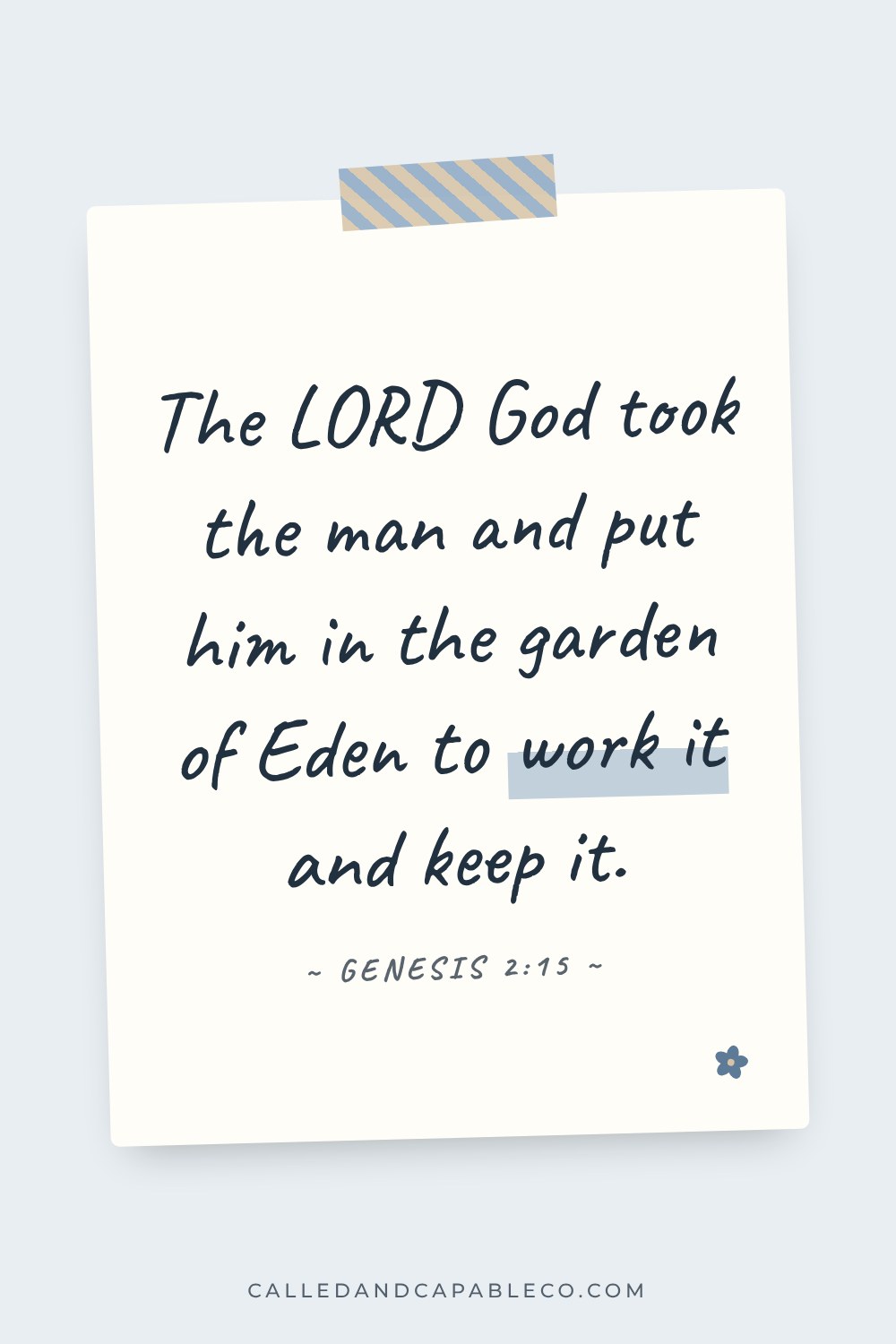
The LORD God took the man and put him in the garden of Eden to work it and keep it.
Genesis 2:15
This one verse has the power to change how you see your job. Let's look at why.
Work came before the fall
This is worth pausing over. In Genesis 1 and 2, everything God made is good. Six times in Genesis 1, God looks at what he has made and calls it good, and at the end, he calls it "very good" (Genesis 1:31). There is no sin, no death, no pain, and no frustration.
And in that perfect world, God gave people work to do.
Adam was placed in the garden to work it and keep it, to cultivate and care for it. And in Genesis 1:28, God gave both the man and the woman the call to "be fruitful and multiply and fill the earth and subdue it, and have dominion" over the creatures. This is often called the cultural mandate: God's commission for humanity to develop, order, and care for his world.
So work is not a punishment. It's part of what it means to be human, made in God's image.
God is a worker
Why would work be part of God's original design? Because God himself is a worker.
The opening chapters of the Bible show God working. He creates, separates, forms, fills, names, and plants. Genesis 2:8 says, "The LORD God planted a garden in Eden." God is pictured as a gardener. Then, on the seventh day, God rests from all his work (Genesis 2:2).
When God made people in his image, he made us to reflect him, including in our work. We take the raw materials of his world, whether soil, numbers, words, ideas, code, fabric, or relationships, and we bring out their potential. We create order, beauty, and usefulness. That's an echo of God's own creative work.
That's true whether you're designing a building, teaching first graders, running payroll, nursing a patient, or organizing a pantry.
Then why does work feel so hard?
Because of Genesis 3. When Adam and Eve disobeyed God, sin entered the world, and everything was affected, including work.
God told Adam:
cursed is the ground because of you; in pain you shall eat of it all the days of your life; thorns and thistles it shall bring forth for you; and you shall eat the plants of the field. By the sweat of your face you shall eat bread...
Genesis 3:17–19
That explains a lot about Monday morning. The frustration, the futility, the broken systems, the difficult people, the effort that seems to go nowhere, the anxiety about money: these are thorns and thistles. Work became painful and frustrating.
But notice something important: the curse fell on work, but it didn't replace work's original purpose. Work is still good. It's now also hard. Both things are true at the same time.
That's why you can love your job and still feel exhausted by it. That's why a calling can still involve tedious tasks. That's why even meaningful work brings frustration.
Work in a broken world
Understanding this helps us avoid two opposite mistakes.
The first mistake is idolizing work: expecting it to give us ultimate meaning, identity, and satisfaction. When we do that, work always disappoints us, because it lives under the curse and can't carry that weight.
The second mistake is despising work: seeing it as meaningless drudgery that has nothing to do with God. When we do that, we miss the dignity and purpose God built into it.
Genesis 2 and 3 together give us a realistic view. Work is good, created by God, and part of our purpose. It's also broken and often painful. We can find real meaning in it without expecting it to be heaven.
Work can be redeemed
The story doesn't end in Genesis 3. In Christ, God is restoring all things, including how we work.
Therefore, my beloved brothers, be steadfast, immovable, always abounding in the work of the Lord, knowing that in the Lord your labor is not in vain.
1 Corinthians 15:58
Paul writes this at the end of a long chapter about the resurrection. Because Jesus rose from the dead, the futility of this world is not the final word. Work done in the Lord isn't wasted.
And the Bible's final picture of the future isn't a world without work. It's a renewed creation, where the curse is gone (Revelation 22:3) and where God's people serve him with joy. The thorns and thistles will be removed. The work will remain good.
Cultivating and keeping
The two verbs in Genesis 2:15, work and keep, offer a helpful way to think about any job.
Cultivate. To cultivate is to develop and make fruitful. Ask: How can I make something better today? A clearer process, a more helpful answer, a well-taught lesson, a more welcoming space, a better product.
Keep. To keep is to guard, protect, and care for. Ask: What am I responsible to protect today? People, resources, trust, quality, safety, a team's morale.
Those questions work just as well in an office, a hospital, or a classroom as they did in a garden.
What this means for your workweek
Genesis 2 can change how you approach your job:
- Your work has dignity. Whether you lead a company or answer phones, you're participating in the kind of work God gave humanity from the beginning.
- Your frustration makes sense. Hard days at work don't mean you're doing something wrong. They mean you live in a fallen world.
- Your work can be worship. You can offer your daily tasks to God as service to him.
- Your work isn't ultimate. It's a good gift, not a god.
Try this at the start of your next workday: before you begin, pray, "Lord, you made me to work. Help me cultivate and keep what you've given me today." It's a small prayer, but it reframes everything.
Start your week with this truth
Genesis 2:15 is Day 1 of our free Monday Reset study, a three-day Bible study for working women that takes about ten minutes a day. It walks through Genesis 2, Psalm 127, and Colossians 3 to help you see your work the way God does, and it ends with a simple page to set your week before the Lord.
Work was God's idea. And he hasn't stopped caring about yours.
Common questions
Is work a curse in the Bible?
No. God gave Adam work in Genesis 2, before the fall. Sin made work painful and frustrating (Genesis 3:17–19), but work itself remains good.
Why does God care about my job?
God is a worker, and he made people in his image to cultivate and care for his world. Ordinary work done in faith can serve him and others.
Scripture quotations are from the ESV® Bible (The Holy Bible, English Standard Version®), © 2001 by Crossway, a publishing ministry of Good News Publishers. Used by permission. All rights reserved.