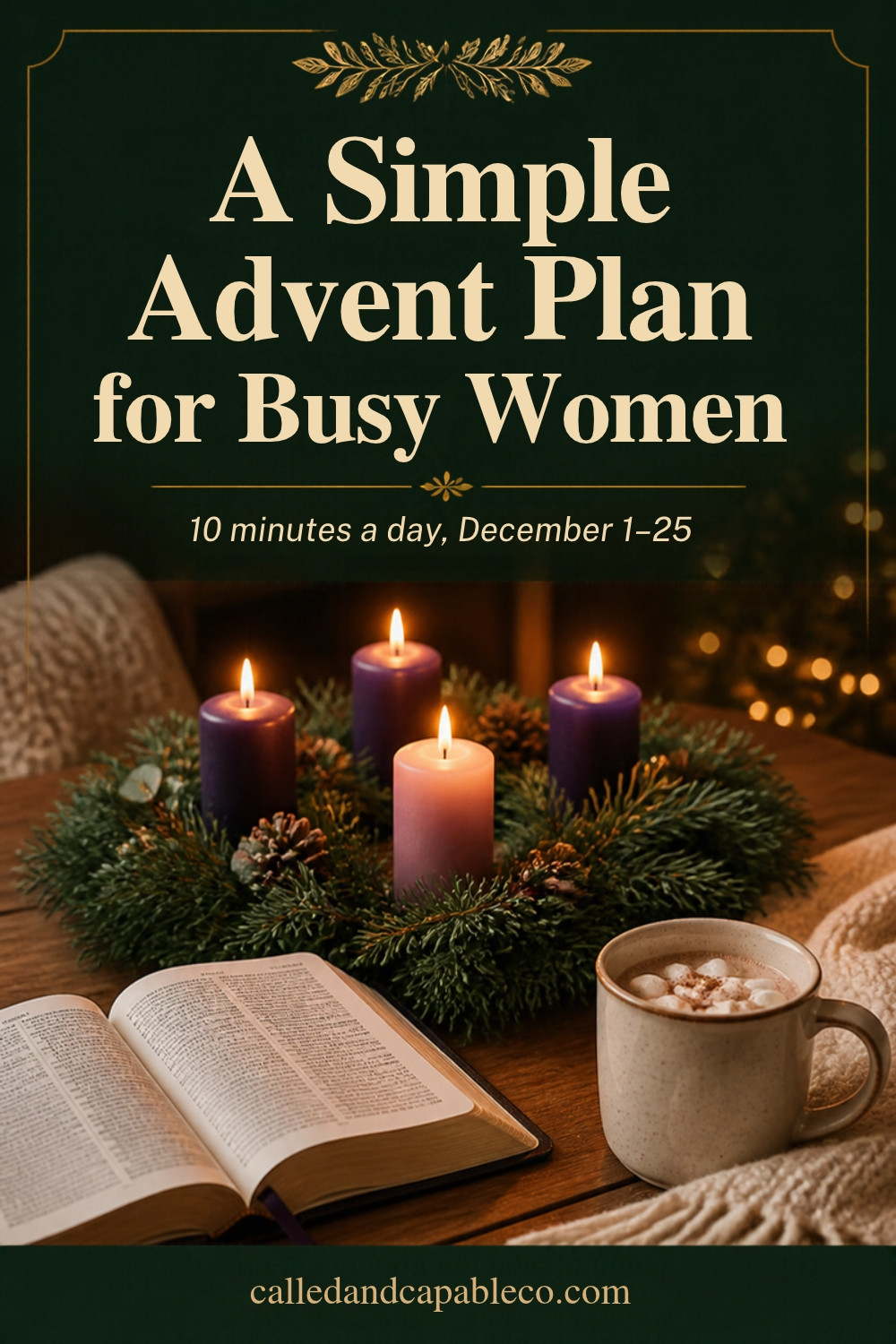
December can be the busiest month of the year. There are year-end deadlines at work, school programs and class parties, gifts to buy and wrap, cards to send, travel to plan, and a full calendar of gatherings. Somewhere in the middle of it all, we hope to actually think about Jesus. A simple Advent devotional for busy women can change that.
Many women start December with good intentions and end it exhausted, wondering where the season went. If that's been your experience, Advent can help.
Advent is a gift for exactly this season. The word comes from a Latin word meaning "coming" or "arrival." For centuries, Christians have used the weeks before Christmas to slow down and remember two things: that Christ came, and that he will come again.
You don't need an elaborate tradition to keep Advent. You need a simple plan you can actually follow. Here's how to build one.
Why Advent is worth it
It's fair to ask whether adding a devotional to December is wise when you're already stretched. But Advent isn't one more task. It's a way to re-center everything else.
When you spend a few minutes each day remembering God's promise and its fulfillment in Christ, the rest of December takes its proper place. The gifts, parties, and traditions become celebrations of something real rather than a frantic production. And when hard things come, like grief that feels sharper during the holidays or stress that peaks before year-end, you have a steady place to turn.
Keep it to ten minutes a day
The best Advent plan is the one you'll still be doing on December 18th. Aim for about ten minutes:
- Read one short passage of Scripture.
- Think about what it shows you about God's promise.
- Pray a sentence or two in response.
- Carry one phrase or idea into your day.
If you can do it with your morning coffee, wonderful. If it happens on your lunch break, in the school pickup line, or at bedtime, that's fine, too. The time of day matters far less than the consistency.
Follow the story from the beginning
Christmas makes the most sense when you see the whole story. Jesus didn't appear out of nowhere. His coming was promised from the very beginning of the Bible.
I will put enmity between you and the woman, and between your offspring and her offspring; he shall bruise your head, and you shall bruise his heel.
Genesis 3:15
Right after Adam and Eve sinned, before God spoke a single word of judgment to them, he promised that a child would come, born of a woman, who would crush the serpent's head even as he himself was wounded. Theologians have long called this verse the first gospel. It's the whole story of Christmas and the cross folded into one sentence.
From there, the promise grows. God tells Abraham that through his offspring all the families of the earth will be blessed (Genesis 12:3). He promises David a son whose kingdom will last forever (2 Samuel 7:16). The prophets describe a child called Immanuel, a ruler from Bethlehem, a servant who would be wounded for our sins. And then, finally:
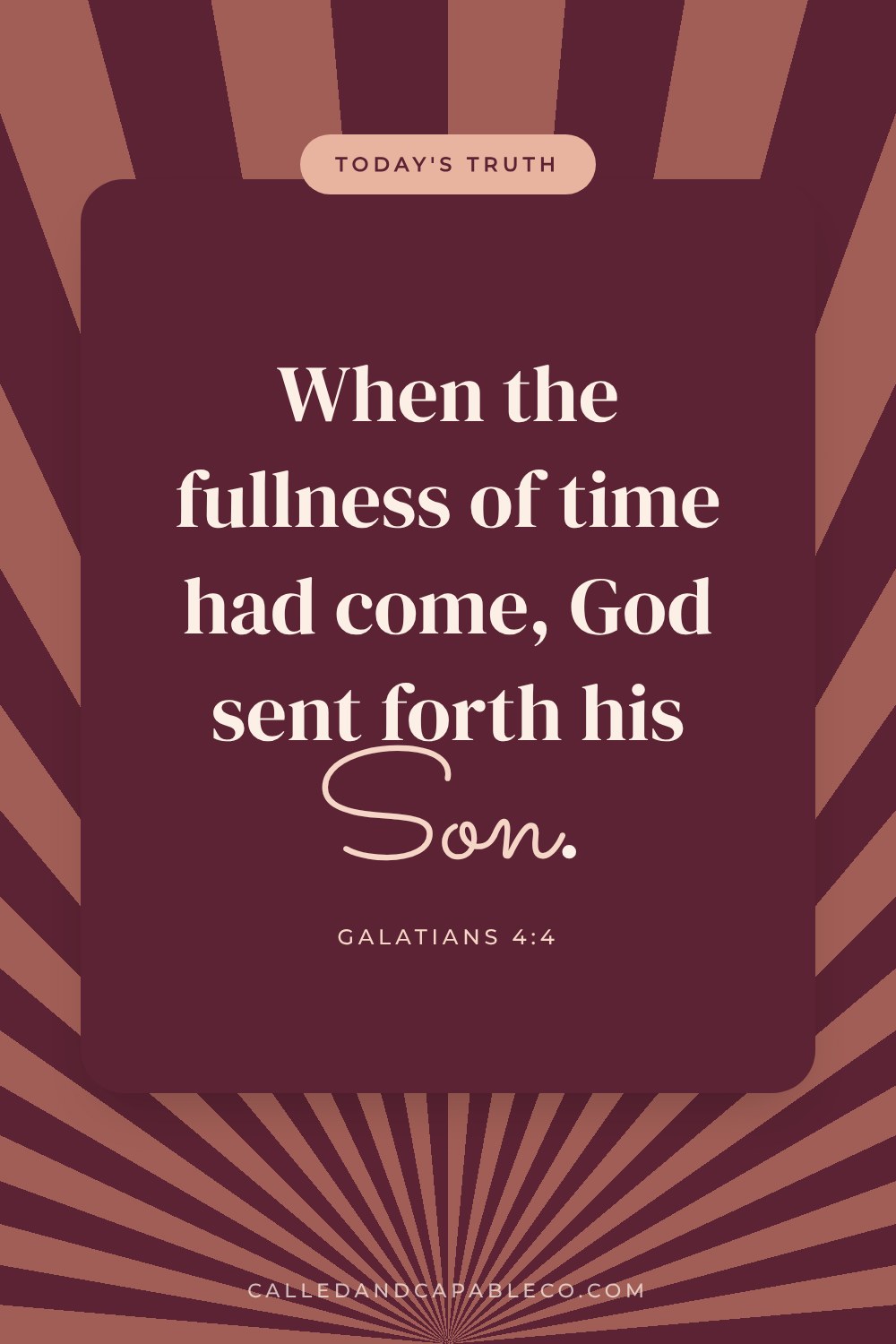
But when the fullness of time had come, God sent forth his Son, born of woman, born under the law, to redeem those who were under the law, so that we might receive adoption as sons.
Galatians 4:4–5
A good Advent plan walks you through that story one day at a time, so that by Christmas morning, you feel the weight and wonder of a promise kept.
A simple four-week outline
If you want to build your own plan, here's a straightforward structure:
- Week 1: The Promise Is Made. Read Genesis 3, Genesis 12, Genesis 22, and 2 Samuel 7. God promises a Savior, a blessing for the nations, a substitute, and an everlasting King.
- Week 2: The Prophets Keep Watch. Read Isaiah 7, 9, 11, 40, and 53, along with Micah 5. The prophets describe who the Messiah will be and where he will come from.
- Week 3: The Arrival Draws Near. Read Luke 1. Zechariah, Elizabeth, and Mary receive the news, and Mary sings her song of praise.
- Week 4: Christ Is Born. Read Matthew 1, Luke 2, and John 1. The Word becomes flesh and dwells among us.
You don't have to read every chapter in full. Choosing a few key verses from each passage works beautifully.
Make it visible
Habits stick when they're easy to see. Put your Bible or Advent devotional somewhere you'll notice it every day, like the kitchen counter, next to the coffee maker, or on your nightstand. If you have kids, read the passage aloud at dinner, even if it's just two or three verses.
Some families light an Advent wreath: four candles, one for each week, with a fifth in the center for Christmas. You don't need anything fancy. Four candles on a plate work. The growing light is a simple reminder that the Light of the world is coming.
Pair Advent with what you're already doing
You don't have to carve out entirely new time. Look for ways to pair Advent with your existing routines:
- Play hymns like "O Come, O Come, Emmanuel" or "Come, Thou Long-Expected Jesus" on your commute.
- Pray through your gift list, thanking God for each person as you shop or wrap.
- Use waiting moments, like lines and traffic, to remember that God's people waited for centuries for the Messiah.
- Read Luke 2 aloud as a family on Christmas Eve.
When you miss a day
You'll probably miss a day or two. A work event runs late, a child gets sick, or you simply forget. That's fine. Read the next day's passage and keep going. You can always circle back on the weekend if you want to.
Advent is not a test. It's an invitation to wait, remember, and worship. God is not grading your December.
Remember he is coming again
Finally, don't forget the second half of Advent. We're not only remembering the baby in the manger. We're also looking forward to the day Christ returns to make all things new. That hope changes how we carry the hard parts of the season: the empty chair at the table, the strained relationship, the diagnosis, the disappointment. The story isn't over. The King is coming back.
Want a guide for all 25 days?
Our printable study, Advent for the Working Woman, follows a four-week path from the garden to the manger, with 25 short readings for December 1 through 25. Each day takes about ten minutes and includes a key verse, a short reflection, one question to answer, and one small action to carry into your workday. Along the way, you'll also meet women God used in the story, like Sarah, Rahab, Ruth, Elizabeth, Mary, and Anna. It's $10, and you can print it today so it's waiting on your counter December 1st.
This December, you don't have to do more. You just need a few quiet minutes a day to remember the One who came, and who is coming again.
Common questions
When does Advent start?
Advent begins on the fourth Sunday before Christmas. Many devotionals simply run from December 1 to December 25 to make it easy to follow.
What should I read during Advent?
A good Advent plan traces God's promise of a Savior: Genesis 3:15, Genesis 12, 2 Samuel 7, Isaiah 7, 9, and 11, Micah 5, Luke 1–2, and John 1.
Scripture quotations are from the ESV® Bible (The Holy Bible, English Standard Version®), © 2001 by Crossway, a publishing ministry of Good News Publishers. Used by permission. All rights reserved.