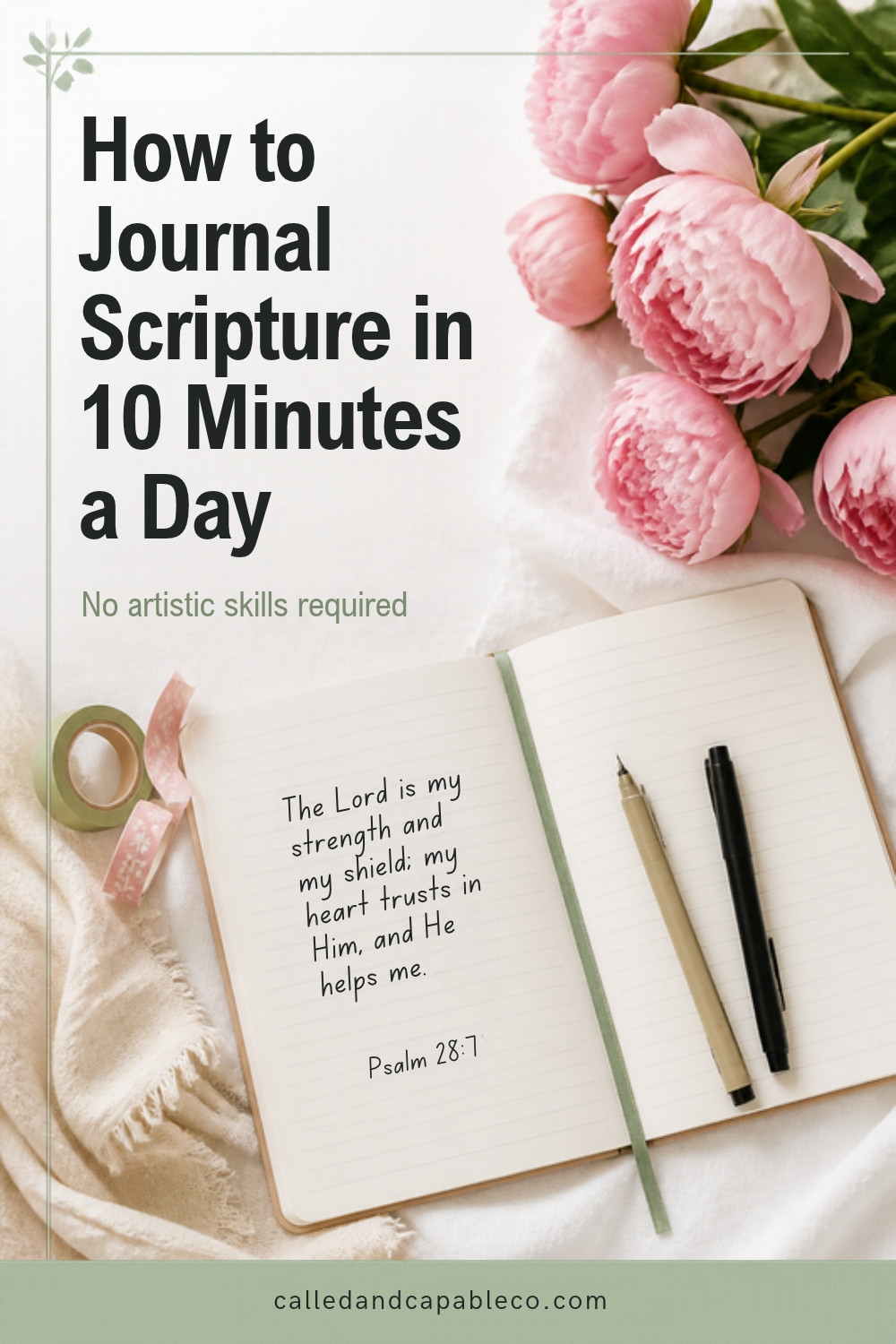
Bible journaling has become popular in recent years. You may have seen beautiful pages online filled with hand lettering, watercolor, and intricate drawings in the margins of wide-margin Bibles. They're lovely. But if you're not artistic, or if you simply don't have time, you might assume journaling isn't for you.
It is. At its heart, Bible journaling for beginners is simply writing down what God is teaching you through his Word. No art supplies, special Bible, or creative talent required. And it can be done in about ten minutes a day.
Why journal at all?
You might wonder why journaling is worth the extra time. Isn't reading enough? Reading is wonderful. But writing adds some unique benefits:
Writing helps us slow down. When we read quickly, our eyes can move across the page while our minds wander to our to-do lists. When we write, we have to think about what we're reading. Copying a verse by hand forces us to notice every word.
Writing helps us remember. Studies show we remember things better when we write them by hand. The verse you copy this morning is more likely to come to mind this afternoon.
Writing helps us respond. It's easy to read a passage and move on. Writing a response turns reading into a conversation with God.
Writing creates a record of God's faithfulness. Months or years later, you can look back through your journal and see how God spoke to you in hard seasons, answered prayers, and grew your faith. That record becomes a powerful encouragement.
God himself told his people to write things down so they would remember. The kings of Israel were even told to write out their own copy of God's law and read it all their lives (Deuteronomy 17:18–19).
What you need
- A Bible
- A simple notebook
- A pen
That's it. Any notebook works: a cheap composition book, a spiral notebook, or a nice journal if you have one. If you enjoy colored pens or highlighters, use them. But don't let supplies become a barrier. The goal is time with God, not a beautiful notebook.

A simple four-step method
Here's a method that fits in about ten minutes:
Step 1: Write the reference and date (1 minute). At the top of the page, write the passage you're reading and today's date. This helps you look back later and track your progress.
Step 2: Read and copy one verse (3 minutes). Read the passage slowly. Then choose one verse that stands out to you and write it out by hand. Copying Scripture is a powerful way to slow down and notice every word.
Step 3: Answer three questions (4 minutes).
- What does this say about God? His character, his promises, his actions.
- What does this say about me or about people? Our needs, our sin, our calling.
- How should I respond today? A truth to believe, a command to obey, a sin to confess, or something to thank God for.
Keep your answers short. A sentence or two each is plenty.
Step 4: Write a one-line prayer (2 minutes). Turn what you've learned into a short prayer. "Lord, help me to..." or "Thank you for..." or "Forgive me for..."
An example entry
Here's what an entry might look like:
Your word is a lamp to my feet and a light to my path.
Psalm 119:105
- About God: He doesn't leave me in the dark. He gives guidance through his Word.
- About me: I often want to see the whole path ahead, but God gives light for the next step.
- Response: Stop worrying about next month's decision and focus on being faithful today.
- Prayer: Lord, give me enough light for today's steps, and help me trust you with the rest.
That's a full, meaningful entry. It took less than ten minutes.
Variations to try
Once you're comfortable with the basic method, you can mix it up:
- Prayer journaling: Write out your prayers in full, then go back weeks later and note how God answered.
- Gratitude journaling: Add three things you're thankful for each day.
- Verse mapping: Take one verse and look up cross-references, key words, and context.
- Sermon notes: Use your journal on Sunday to take notes during the sermon, then review them during the week.
Tips for keeping it going
- Keep your journal with your Bible so it's always ready.
- Don't aim for pretty. Messy handwriting is just fine. This is for you and God, not for social media.
- Skip a day without guilt. Just pick back up the next day. There's no penalty for missed days.
- Review once a month. Flip back through your entries and thank God for what he's taught you. You'll be amazed at how much you've grown.
- Pair it with a reading plan. Knowing what you'll read each day makes journaling easier.
When you don't feel like it
Some days you'll sit down and feel nothing. The words won't come, or the passage seems dry. That's normal. Write something anyway, even if it's just the verse and one sentence. Faithfulness matters more than feelings.
Blessed is the man... his delight is in the law of the LORD, and on his law he meditates day and night.
Psalm 1:1–2
Over time, journaling becomes one of the ways God grows your delight in his Word.
Our free Monday Reset study uses this same rhythm of reading, reflecting, responding, and carrying one truth into your day. It's three days, about ten minutes each, with space to write on every page. It's a perfect first step into Scripture journaling.
Common questions
How do I start Bible journaling?
Get a simple notebook and pen. Read a short passage, copy one verse by hand, answer what it says about God, about people, and how you should respond, then write a one-line prayer.
Do I need to be artistic to journal Scripture?
No. Scripture journaling is simply writing what God is teaching you through his Word. Messy handwriting and plain notebooks work perfectly.
Scripture quotations are from the ESV® Bible (The Holy Bible, English Standard Version®), © 2001 by Crossway, a publishing ministry of Good News Publishers. Used by permission. All rights reserved.