Many women love God and want to know the Bible better, but have never actually been taught how to study it. You open your Bible, read a passage, and wonder, "What am I supposed to get out of this?" Or you rely completely on devotional books, podcasts, or study guides because you're not sure you can understand Scripture on your own.
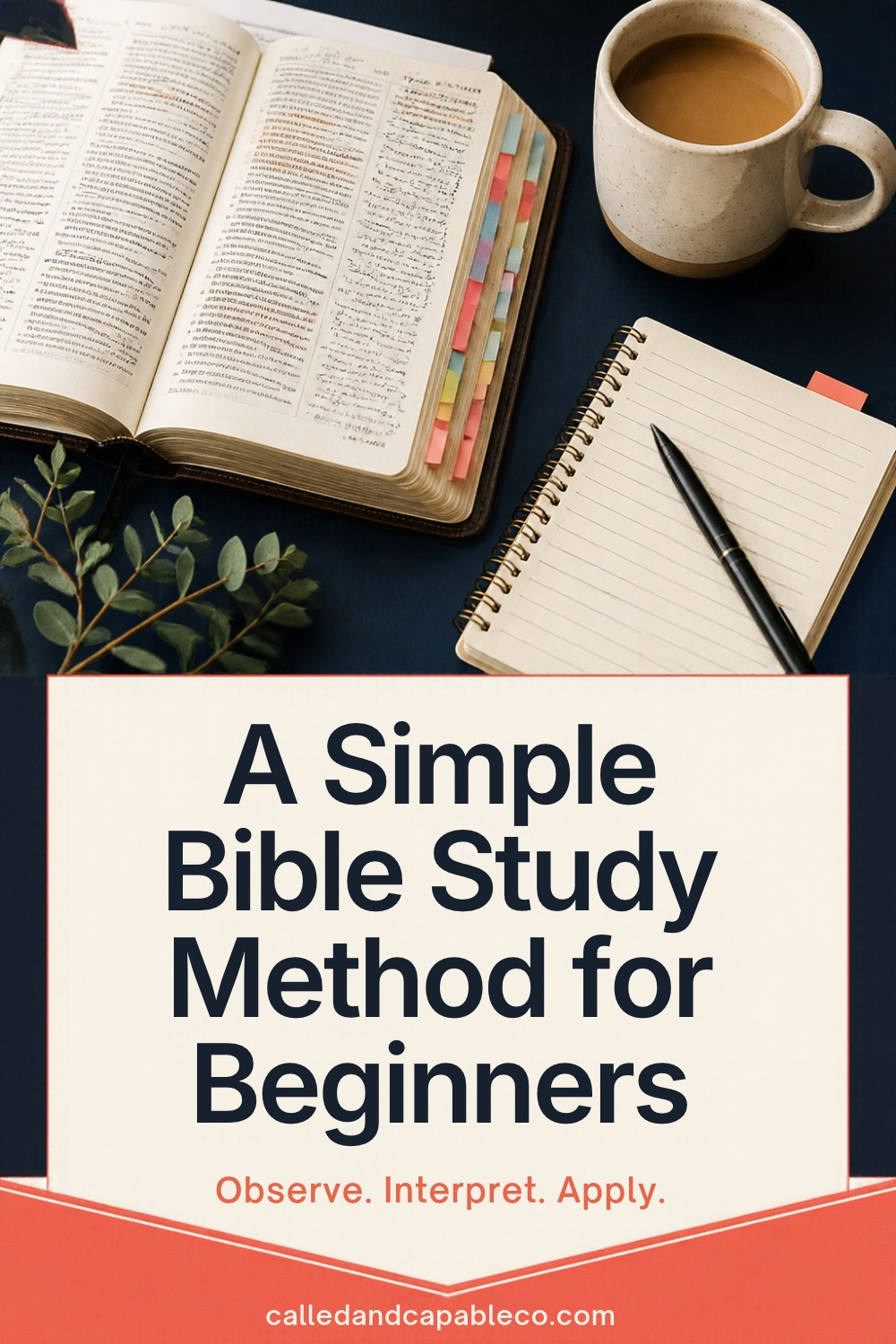
Those resources can be wonderful. But you don't need seminary training to study the Bible well. God gave his Word to ordinary people, and he gives his Spirit to help us understand it. If you've been wondering how to study the Bible for beginners, a simple three-step method can help you understand Scripture on your own: observe, interpret, and apply.
Start with prayer
Before you begin, ask God to help you understand. The Holy Spirit is the one who opens our eyes to the truth of his Word. Bible study isn't just an intellectual exercise. It's a spiritual one.
Open my eyes, that I may behold wondrous things out of your law.
Psalm 119:18
A simple prayer like this before you study invites God into the process and reminds you that you're not just reading a book. You're hearing from the living God.
Step 1: Observe — What does it say?
Read the passage carefully, more than once. Before jumping to what it means or how it applies to you, slow down and notice what's actually there.
This is the most important step, and the one most often skipped. Many misunderstandings of Scripture come from rushing past what the text actually says.
Here are some observation questions to ask:
- Who is speaking or being spoken about?
- What is happening?
- Where and when does this take place?
- Why is this being said or done?
- Are there repeated words or ideas? (Repetition usually signals importance.)
- Are there commands to obey, promises to trust, or warnings to heed?
- What connecting words link ideas, like "therefore," "but," "because," or "so that"?
- Are there comparisons or contrasts?
Write down what you notice. Don't worry about interpreting yet. Just observe. You might be surprised how much you see when you slow down.
Step 2: Interpret — What does it mean?
Now ask what the passage meant to its original readers and what it teaches about God and his people. This step moves from "what does it say?" to "what does it mean?"
Some helpful interpretation questions:
- What is the main point of this passage?
- How does it fit into the surrounding chapter and book? (Always read the verses before and after.)
- What kind of writing is this? A story, a poem, a letter, a prophecy, a law? Different genres are read differently.
- What did this mean to the original audience?
- How does it connect to Jesus and the gospel?
- Does other Scripture help explain it?
That last question is important. Scripture interprets Scripture. If one passage is unclear, others will often shed light on it. The Bible doesn't contradict itself, so clearer passages help us understand harder ones.
A good study Bible can also help with background, context, and cross-references. Just be sure to read the text yourself first, before reading the notes.
Step 3: Apply — How should I respond?
Finally, ask how this truth should shape your life. Application is where Bible study becomes life change.
But be doers of the word, and not hearers only, deceiving yourselves.
James 1:22
Some application questions:
- Is there a sin to confess?
- Is there a promise to trust?
- Is there a command to obey?
- Is there an example to follow or avoid?
- Is there something to praise God for?
- How does this change how I think, feel, or act today?
Be specific. "Be more patient" is vague. "Be patient with my coworker when she interrupts me in meetings this week" is specific and actionable.
Also remember that application flows from interpretation. The question isn't "What do I want this to mean for me?" but "Given what this means, how should I respond?"
Try it with a short passage
Practice this method with a short passage. Some great places to start:
- Psalm 23: God as shepherd
- Philippians 4:4–9: joy, prayer, and peace
- James 1:2–8: trials and wisdom
- John 15:1–11: abiding in Christ
- Ruth 1: loyalty and loss
Spend a few days on one passage. Day one, observe. Day two, interpret. Day three, apply. You may be surprised how much you see.
Helpful tools
You don't need a lot of tools, but a few can help:
- A good translation like the ESV
- A study Bible for background and cross-references
- A notebook to record observations and insights
- A concordance or Bible app to search for words and related passages
Keep the big picture in view
As you study, remember that the Bible is one big story of God's redemption, and all of Scripture points to Christ. Jesus said the Scriptures "bear witness about me" (John 5:39). After his resurrection, he explained to his disciples how Moses and all the Prophets spoke about him (Luke 24:27).
So as you study any passage, keep asking how it shows your need for a Savior and how God provides one in Jesus.
All Scripture is breathed out by God and profitable for teaching, for reproof, for correction, and for training in righteousness, that the man of God may be complete, equipped for every good work.
2 Timothy 3:16–17
Study in community
Personal Bible study is valuable, but it's even richer alongside others. Join a women's Bible study at your church or invite a friend to study the same passage and talk about it. Other believers will notice things you missed, and your pastor and teachers can help guide you.
The Called & Capable Monthly membership, launching January 2027, brings one new 4-week Bible study to your inbox each month, about twelve minutes a day, with a Monday encouragement email and a weekly Reflection Guide. In the meantime, our free Monday Reset study is a great place to start.
Common questions
What is the easiest Bible study method?
The observe, interpret, apply method is simple and effective. Observe what the passage says, interpret what it means, and apply how it should change your life.
What should a beginner study first in the Bible?
Start with a short passage or book, such as Psalm 23, Philippians 4, James 1, or the Gospel of Mark, and take a few days to work through it slowly.
Scripture quotations are from the ESV® Bible (The Holy Bible, English Standard Version®), © 2001 by Crossway, a publishing ministry of Good News Publishers. Used by permission. All rights reserved.